Discover the prophetic link between the peace of Jerusalem and Yeshuah HaMashiach, through El Elyon, Melkitsedek (Melchizedek), and Maryam. A biblical study of shalom, righteousness, and messianic restoration, with trusted references and free resources.
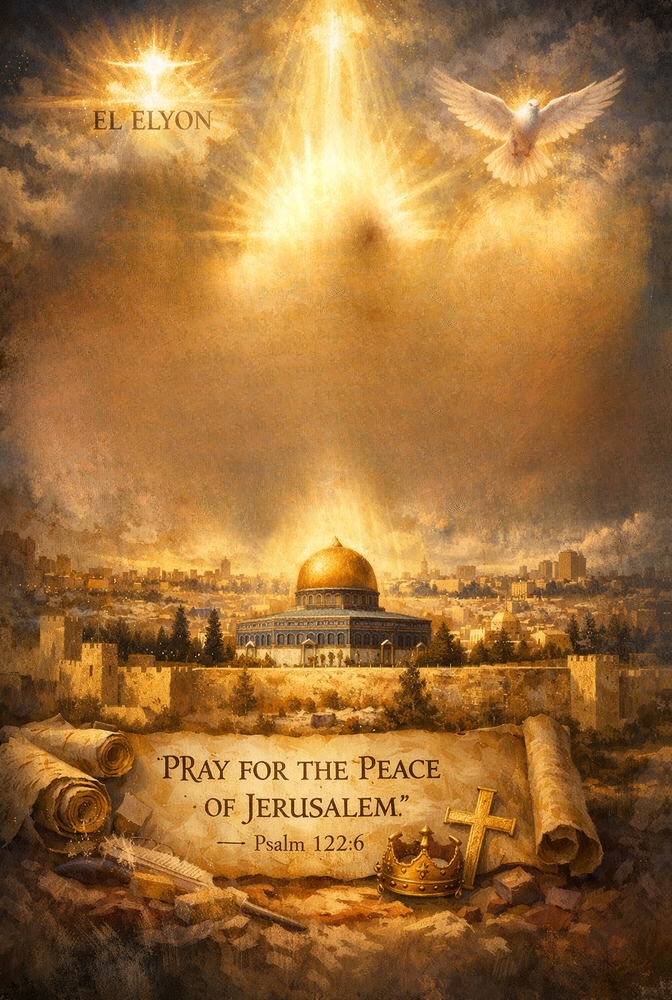
“Pray for the peace of Jerusalem.” (Psalm 122:6)
This biblical command is one of the most repeated spiritual exhortations in Scripture. Yet it is also one of the most misunderstood. Many read it as a religious formula to say, without exploring what “peace” truly means in the biblical worldview—or why Jerusalem carries such spiritual weight in the first place.
If we want to understand the peace of Jerusalem in a profound way, we must read it through the chain of revelation that Scripture itself establishes: El Elyon, Melkitsedek, Yeshuah HaMashiach, and the prophetic symbolism of Maryam.
To explore the foundation of this command, it helps to start directly with the full Psalm that contains it: Psalm 122 (ESV) on Bible Gateway:
https://www.biblegateway.com/passage/?search=Psalm+122&version=ESV
Psalm 122 does not present Jerusalem as a neutral city. It portrays Jerusalem as a place of worship, unity, government, identity, and destiny. The psalmist speaks of joy in going to the “house of YHVH,” then immediately connects that joy to the command to seek the city’s peace.
This tells us something essential: Jerusalem is linked to worship, and worship is linked to peace. In the biblical mind, peace is not purely social; it is covenantal.
Jerusalem: Not Only a City, But a Prophetic Axis
Jerusalem is one of the world’s most examined places, not only for historical reasons but for spiritual reasons. Its name alone has become symbolic of sacred history, religious conflict, and messianic expectation.
For deeper historical and religious context, see the Encyclopaedia Britannica overview of Jerusalem:
https://www.britannica.com/place/Jerusalem
Yet biblically, Jerusalem is more than history. It is a spiritual axis—where covenant, identity, holiness, struggle, and destiny intersect.
That is why Psalm 122 describes Jerusalem as a city “bound firmly together” (Psalm 122:3), then places the responsibility of prayer upon all who love it (Psalm 122:6–9). This is not merely a poetic invitation—it is a covenant alignment.
The question becomes: what kind of peace does the Bible mean?
Shalom: Peace Means Wholeness, Justice, Restoration
When Scripture says “peace,” it speaks of shalom—a word far richer than “absence of war.”
Shalom includes:
- wholeness and healing
- security and protection
- stability and continuity
- moral order and righteousness
- harmony between human life and divine will
This is why the Bible often links peace to righteousness:
“The effect of righteousness will be peace.” (Isaiah 32:17)
So the peace of Jerusalem is not simply a diplomatic outcome. It is the fruit of something deeper: a restored order under the authority of the Most High.
That leads us directly to El Elyon.
El Elyon: The Most High Source of Jerusalem’s Peace
One of the most powerful revelations in Scripture is that peace is not “manufactured” by humans. It flows from divine supremacy.
The name El Elyon appears with great spiritual authority in the first appearance of Melkitsedek. The story is short, but it is foundational. You can read the passage here:
https://www.biblegateway.com/passage/?search=Genesis+14%3A18-20&version=ESV
Genesis reveals:
- Melkitsedek is king of Salem
- He is priest of God Most High (El Elyon)
- He blesses Abram in the name of El Elyon
- El Elyon is the One who delivers enemies and governs outcomes
This matters because Jerusalem’s peace cannot be understood without the idea of spiritual authority over history.
When El Elyon is recognized as Supreme, peace becomes possible—not as a human invention, but as a divine ordering.
Melkitsedek: King of Salem and King of Righteousness — the Blueprint of Peace
Melkitsedek is not only priest. He is king. And that dual identity is one of the Bible’s deepest patterns: peace is priestly and governmental.
The book of Hebrews gives the interpretation of his identity:
“He is first… king of righteousness, and then… king of Salem, that is, king of peace.” (Hebrews 7:2)
You can read Hebrews 7 (ESV) here:
https://www.biblegateway.com/passage/?search=Hebrews+7&version=ESV
This verse becomes a master key.
It reveals a sequence:
Righteousness → Peace
Meaning: peace is not independent. Peace is the result of righteousness. If righteousness collapses, peace becomes fragile.
So the biblical revelation is simple but radical:
Peace without righteousness cannot endure.
Jerusalem’s peace is a righteousness question before it is a diplomacy question.
And this is precisely why Melkitsedek is tied to Salem—the ancient root of “shalom”—and why his symbolic identity becomes prophetic for Jerusalem’s destiny.
Psalm 110: The Order of Melkitsedek Is Messianic
The link between Melkitsedek and Messiah is not an idea invented by theology. It is given directly in Scripture.
Psalm 110 declares:
“You are a priest forever after the order of Melchizedek.” (Psalm 110:4)
You can read Psalm 110:4 (ESV) here:
https://www.biblegateway.com/passage/?search=Psalm+110%3A4&version=ESV
This is where biblical logic becomes unavoidable:
- Melkitsedek is priest of El Elyon
- Melkitsedek embodies righteousness + peace
- Psalm 110 says a future figure will carry that same priesthood forever
The Messianic implication is strong: the final peace requires a final priesthood of righteousness and reconciliation.
This is exactly where Yeshuah HaMashiach enters the chain.
Yeshuah HaMashiach: The Light That Reveals the True Peace
In Messianic understanding, Yeshuah is not merely a messenger of peace. Scripture presents Him as peace itself:
“He Himself is our peace.” (Ephesians 2:14)
And again:
“Making peace through the blood of His cross.” (Colossians 1:20)
This peace is not sentimental calm. It is reconciliation at the root of human hostility.
When Hebrews explains the priesthood “after the order of Melkitsedek,” it makes a direct connection: Yeshuah’s priesthood is superior, eternal, and restorative. That is why the “Melkitsedek line” is not a detail—it is the architecture of messianic peace.
In other words:
If Melkitsedek represents righteous peace in Salem,
Yeshuah represents the fulfillment of that righteous peace for all nations.
So the peace of Jerusalem becomes inseparable from the messianic question:
How can righteousness be restored in human hearts and communities?
The Bible’s answer is: through a priesthood that heals separation, establishes covenant alignment, and restores divine order.
Jerusalem’s Peace Is a Prophetic Destiny, Not a Temporary Moment
One reason the peace of Jerusalem remains difficult is because Scripture presents it as a prophetic unfolding—not a quick achievement.
Isaiah connects peace to Messiah’s government:
“Of the increase of His government and of peace there will be no end… on the throne of David.” (Isaiah 9:7)
Here, peace is described as continuous expansion under divine rule. This confirms the biblical theme: Jerusalem’s peace is a destiny tied to righteousness and divine government.
Maryam: Faith, Purity, and the Inner Dimension of Peace
Many readers ask: Where does Maryam fit into this structure?
Maryam (Mary) is not inserted as a decoration. She fits as a spiritual symbol of the inner condition needed for divine peace to manifest.
In Luke’s narrative, Maryam stands at the intersection of heaven and earth through surrender. The Most High overshadows her:
“The power of the Most High will overshadow you.” (Luke 1:35)
This connects Maryam directly to the “Most High” logic—El Elyon’s supremacy over the human world.
Maryam represents:
- humility without weakness
- faith without control
- purity without pride
- surrender without passivity
And that is a profound key: peace is not only external. Peace begins internally.
If Jerusalem mirrors humanity’s spiritual condition, then Maryam symbolizes the opposite of chaos: alignment, purity, and receptivity to divine will.
This is why Maryam can be seen as a bridge of faith—a sign that true peace begins with the restoration of the inner temple.
A Living Artistic Bridge: “Maria — Model Perfect Faith” (Exhibition)
If you want to experience this Maryam theme through visual contemplation, explore the exhibition:
Maria — Model Perfect Faith
See the online exhibition here
This exhibition works like a spiritual mirror—inviting reflection on faith, purity, sacred presence, and the inner dimension of peace.
A Historical Layer: The Dead Sea Scrolls and the Expectation of Restoration
To understand how ancient faith communities perceived covenant, priesthood, and end-time restoration, the Dead Sea Scrolls are an important historical window.
For a strong introduction, see Britannica’s overview here:
https://www.britannica.com/topic/Dead-Sea-Scrolls
Without forcing interpretation, this historical background confirms one major point: the world of Second Temple Judaism carried intense expectations about priesthood, purification, covenant renewal, and the coming fulfillment of God’s purposes.
In that context, the Melkitsedek priesthood theme becomes even more striking—because it speaks of a priesthood beyond ordinary limitation, tied to divine government and righteousness.
The Core Conclusion: Righteousness and Peace Are One System
The Bible does not separate peace from righteousness. They function together like two wings.
That is why the Melkitsedek identity remains central:
- King of righteousness
- King of peace
And that is why the Messianic fulfillment matters:
- Yeshuah brings reconciliation
- reconciliation restores righteousness
- righteousness produces enduring peace
This is the spiritual logic behind Psalm 122.
Free Book Download: YESHUAH—THE LIGHT OF THE WORLD (Volume VI — The Divine Names)
If you want to go deeper into the revelation of Yeshuah HaMashiach as Light, and explore the Divine Names with spiritual clarity, I invite you to download this free resource:
YESHUAH—THE LIGHT OF THE WORLD
Volume VI — The Divine Names
https://payhip.com/b/WGzj2
Help Distribute These Free Resources Worldwide
If this message speaks to your spirit, do not keep it to yourself.
Share these free resources worldwide:
- Share this article
- Share the exhibition experience
- Share the free book landing page
- Send them to churches, Bible groups, interfaith communities, and spiritual seekers
- Post them across your networks (Facebook, WhatsApp, Telegram, X, YouTube, and blogs)
Because the peace of Jerusalem is not only something to discuss.
It is a prophetic call to spread light, righteousness, reconciliation, and truth across nations.